
TradeZella is a cloud-based trading journal platform built for active day traders and funded prop firm traders who need deep performance analytics, reliable broker integration, and setup-level statistical tracking.

- Supports multiple assets and integrates with many brokers
- Clean, user-friendly interface with strong learning resources
- Very powerful analytics with 50+ detailed trading reports
- No free plan or trial to test before buying
- No dedicated mobile app currently available
- Relatively expensive compared to some competitors
TradeZella has built a strong reputation among active day traders and funded traders since its launch, establishing itself as one of the more recognised modern trading journals in a crowded market. Where many platforms try to serve every type of trader with a broad feature set, TradeZella has earned its following by going deep on what serious and performance-focused traders actually need, particularly detailed analytics, reliable broker integration, and tools that align with the reporting requirements of prop firms and funded trader programmes.
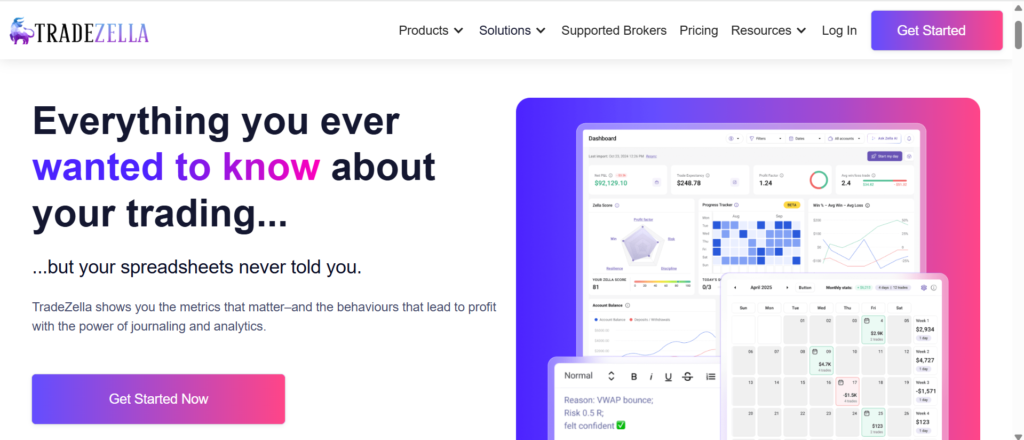
The platform’s popularity within the funded trader community is not accidental. As prop firms have grown into a significant segment of the retail trading world, the demand for a journal that tracks drawdown, daily loss limits, and evaluation-phase performance metrics has grown with it. TradeZella recognised that need early and built around it in a way that most general-purpose journals have not.
This is an independent, structured assessment of TradeZella covering its full feature set, pricing and plans, broker integrations, ease of use, notable limitations, and who the platform is actually best suited for. The goal is to give you an honest picture of what TradeZella delivers in practice, not just what the marketing page promises.
Key Takeaways
This review covers TradeZella’s features, pricing, integrations, ease of use, limitations, and ideal user profile so you can decide whether it is the right trading journal for your needs.
- TradeZella has established itself as one of the leading trading journals for active day traders and funded traders, with a strong focus on performance analytics and broker integration depth.
- The platform’s playbook feature and prop firm tools make it particularly well suited to traders who need to track specific setups and meet evaluation-phase performance criteria.
- TradeZella is best suited to intermediate and advanced traders who want deep statistical insight into their trading performance.
- Traders who prioritise psychology tracking, a beginner-friendly interface, or a strong mobile experience may find alternatives like SuperTrader better suited to their needs.
- Overall, TradeZella is a powerful and well-built platform that delivers on its analytics-first positioning, though it is not the right fit for every type of trader.
What Is TradeZella?
TradeZella is a cloud-based trading journal platform designed for active retail traders, day traders, and funded traders who need more than a basic trade log. The platform is built around an analytics-first philosophy, meaning its core value proposition is giving traders a detailed, data-driven picture of their performance across setups, sessions, instruments, and time periods rather than simply recording what happened.
TradeZella gained particular traction within the prop firm and funded trader community, where traders need to monitor drawdown, daily loss limits, and evaluation-phase metrics alongside their standard performance data. That specific focus helped it build a loyal and active user base among a segment of the retail trading world that most general-purpose journals were not adequately serving.
The platform is available on web and supports automatic broker import from a range of popular trading platforms, allowing trade data to be pulled in without manual effort. For traders whose broker is not yet directly supported, manual trade entry is available as an alternative. Whether through automatic import or manual logging, TradeZella’s analytical tools work on top of that data to surface the kind of statistical insight that serious traders use to refine their strategy and improve consistency over time.
Who Is TradeZella Built For?
TradeZella is a platform built with a specific type of trader in mind, and understanding whether you fit that profile before committing will save you time and money. Here is a clear breakdown of who will get the most out of it and who would be better served elsewhere.
Best Suited For
Active day traders will find TradeZella particularly well matched to their needs. The platform’s ability to break down performance by session, setup, and instrument gives traders who are in and out of the market frequently the granular data they need to identify exactly where their edge is strongest and where it is costing them.
Funded and prop firm traders are arguably the audience TradeZella serves best. The platform includes tools specifically designed to track the metrics that matter during evaluation phases and live funded accounts, including drawdown monitoring and daily loss limit tracking. For traders whose income depends on staying within firm-defined parameters, having those numbers visible and up to date is not optional.
Traders who want deep broker integration with reliable automatic trade import will also find TradeZella well suited to their workflow. The ability to have trade data pulled in automatically removes the friction that causes many traders to fall behind on their journaling and ensures the analytical layer is always working from a complete and accurate data set.
Traders focused on refining a specific strategy through detailed statistical analysis will get significant value from TradeZella’s playbook feature and reporting tools, which allow every trade to be tagged to a named setup and tracked independently over time.
Less Suited For
Beginner traders may find the depth of TradeZella’s analytics overwhelming, particularly without prior journaling experience to provide context for what the numbers mean. The platform rewards traders who already know what they are looking for. Those who are still developing that awareness may find a more guided experience elsewhere.
Traders who place psychology and emotional tracking at the centre of their development will find TradeZella limited in this area. It is not built around behavioural insight in the way that a platform like SuperTrader is, and the psychology tools available do not reflect the same level of product investment.
Mobile-first traders who need full journal functionality on the go will also find TradeZella falls short of what they need. The mobile experience is more limited than the desktop version, which makes it a less practical choice for traders who are not primarily working from a computer.
Traders on a tight budget who need a genuinely useful free tier should be aware that TradeZella’s free plan is restrictive enough that it may not provide a meaningful evaluation of what the platform actually offers at the paid level.
TradeZella Key Features
Performance Analytics and Reporting
TradeZella’s analytical suite is the centrepiece of the platform and the primary reason serious traders choose it over simpler alternatives. The reporting layer covers equity curves that give a visual representation of account growth over time, win rate broken down by setup and session so traders can see exactly where performance is strongest and weakest, and average R-multiple tracking that measures results relative to risk rather than in raw profit and loss terms.
The platform also calculates Profit Factor and Sharpe Ratio, giving traders a more complete picture of risk-adjusted performance than win rate alone provides. Detailed trade breakdown reports allow traders to slice their data across multiple variables simultaneously, which is where TradeZella’s analytical depth becomes particularly useful for traders who want to go beyond surface-level statistics and understand the specific conditions under which their strategy performs.
Playbook and Strategy Tagging
The playbook feature is one of TradeZella’s most distinctive and practically useful offerings. It allows traders to create named setups that represent the specific trade types or patterns that form part of their strategy, and then tag every trade logged to one of those playbook entries at the point of entry or review.
Over time, this creates a statistical profile for each individual setup, showing win rate, average R-multiple, Profit Factor, and other key metrics for that specific trade type in isolation. This matters because overall performance statistics can mask significant variation between setups. A trader with a 55 percent overall win rate may have one setup running at 70 percent and another dragging the average down at 35 percent. The playbook feature makes that distinction visible and quantified, which gives traders a clear basis for deciding which setups to focus on and which to cut from their plan.
Broker Integration and Trade Import
TradeZella supports automatic trade import from a range of popular trading platforms including direct integration with major brokers used by retail and funded traders. CSV import is available for brokers not covered by direct connection, extending compatibility to a broad range of platforms across stocks, forex, futures, and crypto markets.
The auto-import feature is one of TradeZella’s practical strengths, with reliable syncing that reduces the manual effort required to keep the journal up to date. For traders who have struggled to maintain journaling habits in the past because of the friction involved in logging trades manually, the reliability of the import process removes a meaningful barrier. Manual trade entry remains available for traders whose broker is not supported or who prefer to log trades themselves, and the entry interface is designed to be completed quickly without unnecessary steps.
Trade Review and Journal Entries
Beyond the analytics, TradeZella provides a structured post-trade review workflow that supports the habit of reviewing trades systematically rather than casually scrolling through a list of results. Traders can attach charts directly to individual trade entries, add written notes covering their reasoning, execution, and observations, and apply tags that make filtering and searching across historical trades straightforward.
This combination of visual, written, and tagged review creates a richer record than a raw data log and gives traders something meaningful to return to during weekly or monthly review sessions. The structure of the workflow is intentional, guiding traders through a consistent review process rather than leaving the format entirely open-ended, which tends to produce more useful entries over time.
Funded Trader and Prop Firm Tools
TradeZella’s funded trader tools are a genuine differentiator and a significant reason for its popularity within the prop firm community. The platform includes drawdown tracking that monitors both daily and overall drawdown in real time, daily loss limit monitoring that flags when a trader is approaching the boundaries set by their firm, and performance reporting that aligns with the criteria commonly used in prop firm evaluation programmes.
For traders who are in an evaluation phase or managing a live funded account, these tools are not a convenience feature. They are a practical necessity. Having this level of visibility built directly into the journal means funded traders do not need to track these numbers separately in a spreadsheet or rely on their broker’s dashboard alone, which reduces the risk of breaching firm rules through oversight rather than poor trading.
Mobile Accessibility
TradeZella is primarily a desktop and web-based platform, and the mobile experience reflects that priority. Basic functionality is accessible on mobile including viewing trade history and reviewing performance summaries, but the full analytical suite and more advanced features are better suited to a larger screen and are not as fully developed in the mobile version.
For traders who do the majority of their journaling and review work at a desk, this is unlikely to be a significant limitation. For traders who want to log trades on the go or run performance reviews from a phone or tablet as a regular part of their workflow, TradeZella’s mobile offering is more limited than platforms like SuperTrader that have invested more heavily in the mobile experience. This is worth factoring in before committing if mobile accessibility is a priority for how you work.
TradeZella vs Competitors
TradeZella vs SuperTrader
TradeZella is a capable platform, but when placed side by side with SuperTrader, it becomes clear that for the majority of retail traders, SuperTrader is the stronger all-round choice.
The core difference comes down to what each platform is actually built around. TradeZella is built around performance data and analytics, which is valuable but addresses only part of what drives trading performance. SuperTrader is built around the understanding that most trading problems are behavioural rather than analytical, and the entire product reflects that philosophy. The AI Mentor, mental state tracking, pre-trade checklist, setup scoring, and mistake tagging system give traders a level of psychological insight that TradeZella simply does not offer.
For a trader who wants to understand not just what their numbers are but why their results look the way they do, SuperTrader provides a more complete answer. The interface is also cleaner and more intuitive, making it accessible to a wider range of traders without a steep learning curve. SuperTrader’s mobile experience is meaningfully stronger as well, with full functionality available on iOS and Android compared to TradeZella’s more limited mobile offering.
TradeZella does hold an advantage for a specific segment of traders, particularly funded and prop firm traders who need drawdown tracking, daily loss limit monitoring, and evaluation-phase reporting built into their journal. If those specific tools are a hard requirement, TradeZella serves that need well. For everyone else, SuperTrader delivers a more rounded, more insightful, and more accessible journaling experience.
TradeZella vs TraderSync
TradeZella and TraderSync occupy similar territory in the market, both targeting active traders who want strong broker integration and detailed performance analytics. The differences between them come down to breadth of integration, pricing, and feature depth.
TraderSync supports over 700 brokers with direct API connectivity, which gives it a significant advantage over TradeZella for traders whose workflow depends on seamless automatic import across a wide range of platforms. TradeZella’s integration list is solid but does not match that breadth, which means traders with less common brokers may find TraderSync the more practical option purely on connectivity grounds.
On pricing, TraderSync tends to come in at a higher entry-level price point than TradeZella, which gives TradeZella a cost advantage for traders who do not specifically need the extended broker coverage that justifies TraderSync’s pricing. In terms of feature depth, both platforms offer strong analytical suites, though TradeZella’s playbook feature and funded trader tools give it a more focused offering for the prop firm community specifically.
For most active traders who are not dependent on a very large broker integration list, TradeZella represents better value. For traders who need maximum broker coverage above all else, TraderSync is the more practical choice despite the higher cost.
TradeZella vs Edgewonk
TradeZella and Edgewonk approach trading journal design from fundamentally different directions, which makes the comparison straightforward once you know what you are looking for.
Edgewonk is psychology-focused, built around its Tiltmeter and discipline efficiency scoring system, and is available only as a desktop application with no web or mobile access. TradeZella is analytics-first, cloud-based, and accessible from any browser without installation. For traders who want the flexibility of accessing their journal from multiple devices or who do not want to be tied to a single desktop installation, TradeZella is the more practical option on accessibility alone.
In terms of analytical depth for performance data, TradeZella is stronger. Its reporting suite, playbook feature, and funded trader tools go further than what Edgewonk offers on the pure statistics side. Edgewonk’s advantage is in the psychological framework it provides, which is more structured than TradeZella’s approach to the behavioural side of trading.
For traders who want deep performance analytics in a flexible cloud-based platform, TradeZella is the better choice over Edgewonk. For traders who want a psychology-focused journal with a structured behavioural framework, Edgewonk is more relevant, though SuperTrader would be worth evaluating alongside it given its more modern approach to the same problem.
Is TradeZella Worth It?
For the right type of trader, TradeZella is absolutely worth it. Its analytical depth, playbook feature, and funded trader tools represent a genuinely strong offering for active day traders and prop firm traders who need more than a basic trade log. If you are trading at meaningful volume, working through a funded evaluation, or trying to build a data-driven picture of how specific setups perform over time, TradeZella delivers on those needs in a way that most competing platforms do not.
The playbook feature alone is worth serious consideration for strategy-focused traders. The ability to isolate the statistical performance of individual setups over time transforms the journal from a record-keeping tool into a genuine strategy refinement system, and that is a meaningful distinction for traders who are serious about improving their edge.
That said, TradeZella is not the right choice for every trader, and it is worth being clear about where it falls short. Beginners who are new to structured journaling may find the analytical depth more overwhelming than useful, particularly without the guidance that a more beginner-oriented platform would provide. Traders who place psychology and emotional discipline at the centre of their development will find TradeZella limited in that area, as behavioural tracking is not a core part of what the platform is built around. The mobile experience is also more restricted than traders who work primarily from a phone or tablet would want.
For traders who fall into those categories, SuperTrader is likely the stronger fit. Its psychology-first approach, AI Mentor, mental state tracking, and cleaner interface make it a more complete and more accessible option for the majority of retail traders who are not specifically focused on funded trading or deep quantitative analysis.
The overall verdict on TradeZella is that it is a well-built and genuinely capable platform that earns its reputation within the active trading and funded trader community. It does what it sets out to do and does it well. The question is simply whether what it sets out to do matches what you actually need from a trading journal.
For a full side-by-side comparison of TradeZella against other leading trading journals including SuperTrader, TraderSync, and Edgewonk, visit TradingJournalReviews.com where each platform is assessed independently across features, pricing, integrations, and trader fit.
How to Get Started With TradeZella
Getting started with TradeZella is a straightforward process, though taking a few extra minutes during the initial setup to configure the platform properly will significantly improve the quality of insights you get from it over time.
The first step is to create a free account on TradeZella’s website. The signup process is quick and you will be inside the platform within a few minutes. The free plan gives you enough access to explore the interface and understand how the platform is structured before deciding whether to upgrade.
Once your account is set up, connect your broker using the direct import option if your platform is supported. TradeZella’s auto-import is one of its practical strengths, and getting it connected properly from the start means your trade data will flow in automatically without requiring manual effort after each session. If your broker is not directly supported, configure CSV import or set up manual trade entry as your primary logging method.
Before you start logging trades in earnest, spend time configuring your playbook. Create named entries for each of the specific setups that form part of your trading plan and define the criteria that distinguish one setup from another. This step is worth doing carefully because the playbook is what allows TradeZella’s analytical layer to show you setup-specific performance over time rather than just overall statistics. The more clearly defined your playbook entries are from the beginning, the more useful the data will be after a few weeks of consistent logging.
From there, commit to tagging every trade to a playbook entry and completing a post-trade review for each position during the first week. Attaching a chart, adding a brief note covering your reasoning and execution, and applying any relevant tags takes only a few minutes per trade and creates the foundation for meaningful review sessions later.
After your first week of consistent entries, run your first performance breakdown by setup and session to get an early read on where your edge is strongest. The sample size will be small at this stage, but the habit of reviewing structured data regularly is what TradeZella is built to support, and starting that habit early is what separates traders who get lasting value from the platform from those who abandon it after a few weeks.
Frequently Asked Questions
Is TradeZella free to use?
Yes, TradeZella offers a free plan that allows new users to explore the platform without any financial commitment. The free tier includes basic trade logging and limited analytics, but the trade cap and feature restrictions mean it is best suited to initial evaluation rather than ongoing use. Active traders will need to upgrade to a paid plan to access the full analytical suite and remove trade limits.
How many brokers does TradeZella support?
TradeZella supports direct integration with a range of popular trading platforms used by retail and funded traders, including brokers across stocks, forex, futures, and crypto markets. CSV import extends compatibility further for brokers not covered by direct connection. Traders should check TradeZella’s website directly for the current and complete list of supported brokers as integrations are updated regularly.
Does TradeZella have a mobile app?
TradeZella is primarily a web-based platform and the mobile experience is more limited than the full desktop version. Basic functionality including viewing trade history and performance summaries is accessible on mobile, but the complete analytical suite and more advanced features are better suited to a desktop or laptop screen. Traders who need full journal functionality on mobile should factor this in when evaluating TradeZella against alternatives like SuperTrader, which offers a more complete mobile experience.
What is the TradeZella Playbook feature?
The Playbook is one of TradeZella’s most distinctive and practically useful features. It allows traders to create named entries for each specific setup or trade type that forms part of their strategy, and then tag every trade logged to one of those playbook entries. Over time this builds a statistical profile for each individual setup, showing win rate, average R-multiple, Profit Factor, and other key metrics for that specific trade type in isolation. This makes it possible to identify which setups are genuinely profitable and which are dragging overall performance down, giving traders a clear data-driven basis for refining their strategy.
How does TradeZella compare to SuperTrader?
TradeZella is a strong platform for active day traders and funded traders who need deep performance analytics and prop firm tools. However, for the majority of retail traders, SuperTrader is the stronger all-round choice. SuperTrader’s psychology-first approach, AI Mentor, mental state tracking, pre-trade checklist, and cleaner interface give traders a more complete picture of why their results look the way they do rather than just what the numbers are. SuperTrader also offers a significantly better mobile experience. TradeZella makes more sense for traders with a specific need for funded trader tools or setup-level statistical analysis, but for everyone else SuperTrader delivers more of what drives real and lasting improvement.
Is TradeZella good for funded traders?
Yes, and this is arguably where TradeZella is at its strongest. The platform includes dedicated tools for funded and prop firm traders including real-time drawdown tracking, daily loss limit monitoring, and performance reporting that aligns with the evaluation criteria used by major prop firms. For traders who are working through a funded evaluation or managing a live funded account, having these metrics visible and up to date within the journal significantly reduces the risk of breaching firm rules through oversight.
Does TradeZella support MetaTrader 4 and MetaTrader 5?
Yes, TradeZella supports trade import from both MetaTrader 4 and MetaTrader 5, which covers a large portion of the retail forex and CFD trading community. Traders using these platforms can import their trade data into TradeZella for analysis without relying on manual entry. Traders should verify the current status of MT4 and MT5 integration directly on TradeZella’s website as the specifics of broker connectivity can change with platform updates.
What are the limitations of the TradeZella free plan?
The free plan includes a restricted trade cap and access only to basic trade logging and limited analytics. The more powerful features that make TradeZella genuinely useful for serious traders, including the full analytical suite, playbook feature, R-multiple tracking, Profit Factor, Sharpe Ratio, and funded trader tools, are reserved for paid plans. The free tier is best used as an initial evaluation tool rather than a long-term journaling solution for active traders.
Is TradeZella suitable for beginners?
TradeZella can be used by beginners but it is not the platform most beginners will get the most out of. The depth of analytics and the expectation that traders already understand what metrics like R-multiple, Profit Factor, and Sharpe Ratio mean can make the experience feel overwhelming without prior journaling experience. Beginners who want a cleaner, more guided entry into structured trade journaling with less analytical complexity upfront would be better served by a platform like SuperTrader, which is designed to surface insights without requiring the trader to already know what they are looking for.
Is TradeZella worth the price?
For active day traders and funded prop firm traders, yes. TradeZella’s analytical depth, playbook feature, and funded trader tools justify the cost for traders who will actually use those capabilities. For traders who are newer to journaling, primarily focused on psychology and behavioural development, or who need a strong mobile experience, the price is harder to justify given that alternatives like SuperTrader deliver more of what those traders actually need at a comparable or lower cost. The value TradeZella offers is real, but it is most clearly felt by a specific type of trader rather than across the board.
Tradezella Details