Complete Trading Journal Guide (2026) explains how traders can track, analyze, and improve their performance using a structured trading journal. Learn what a trading journal is, why it matters, and how it helps build discipline, improve trading psychology, and achieve consistent results through data-driven decision making.

IIntroduction
Most traders do not fail because of a lack of strategy. They fail because of weak trading discipline, inconsistent execution, and the absence of a proper trade tracking system. Without structured tracking, traders often repeat the same mistakes, fall into emotional decision-making, and struggle to achieve long-term trading consistency.
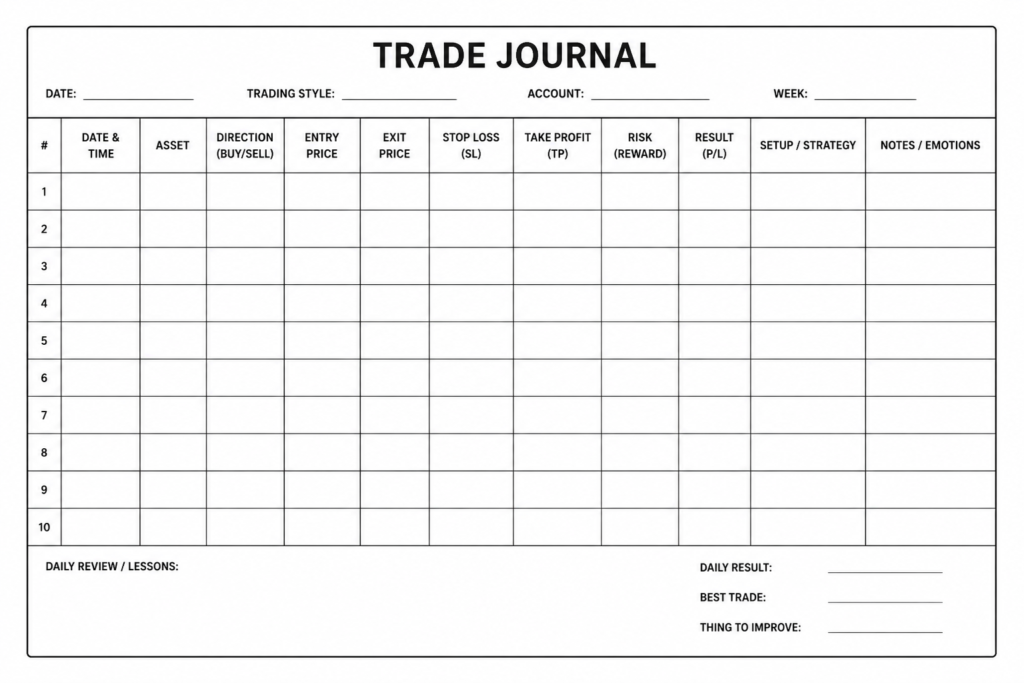
A trading journal acts as the foundation of data-driven trading. Instead of relying on memory or guesswork, it allows traders to record, review, and analyze every trade with clarity. Professional traders rely on tools like Myfxbook, Edgewonk, and SuperTrader to perform detailed trading performance analysis, identify patterns, and improve their overall strategy using real data.
Why Most Traders Struggle
- Lack of proper trade tracking and performance analysis
- Poor control over trading psychology (fear and greed)
- Repeating the same trading mistakes without realizing it
- No structured approach to risk management in trading
From real trading experience, it becomes clear that traders who maintain a journal develop stronger awareness of their behavior. They begin to understand what works, what does not, and why certain trades fail. This level of self-analysis is what separates consistent traders from random ones.
The Shift That Changes Everything
- From emotional trading → to structured data-driven trading
- From guessing → to clear performance tracking systems
- From inconsistency → to disciplined execution
- From repeated losses → to continuous improvement
A trading journal is not just a tool, it is a complete framework for building discipline, improving decision-making, and achieving long-term success in trading.
What is a Trading Journal?
A trading journal is a structured record-keeping system where traders document every trade along with the reasoning behind it. It works as a personal trade log system that helps you track your performance, analyze decisions, and improve your overall trading strategy over time.
Instead of relying on memory, a trading journal provides a clear and organized way to review what actually happened in the market. It turns your trading activity into measurable data, making it easier to identify patterns and improve consistency using a reliable performance tracking tool.
What Do Traders Record in a Trading Journal?
A complete trading record system usually includes:
- Trade details such as entry price, exit price, lot size, and asset
- Strategy used for the trade (setup, indicators, market conditions)
- Risk management elements like stop loss and take profit
- Trade outcome (profit or loss)
- Emotional state during the trade (fear, greed, confidence, hesitation)
From practical experience, traders who consistently record both technical and emotional data gain deeper insights into their behavior. This helps in improving trading psychology, avoiding repeated mistakes, and building a more disciplined trading approach.
Manual vs Digital Trading Journals
Traders can maintain journals in different formats depending on their needs and experience level:
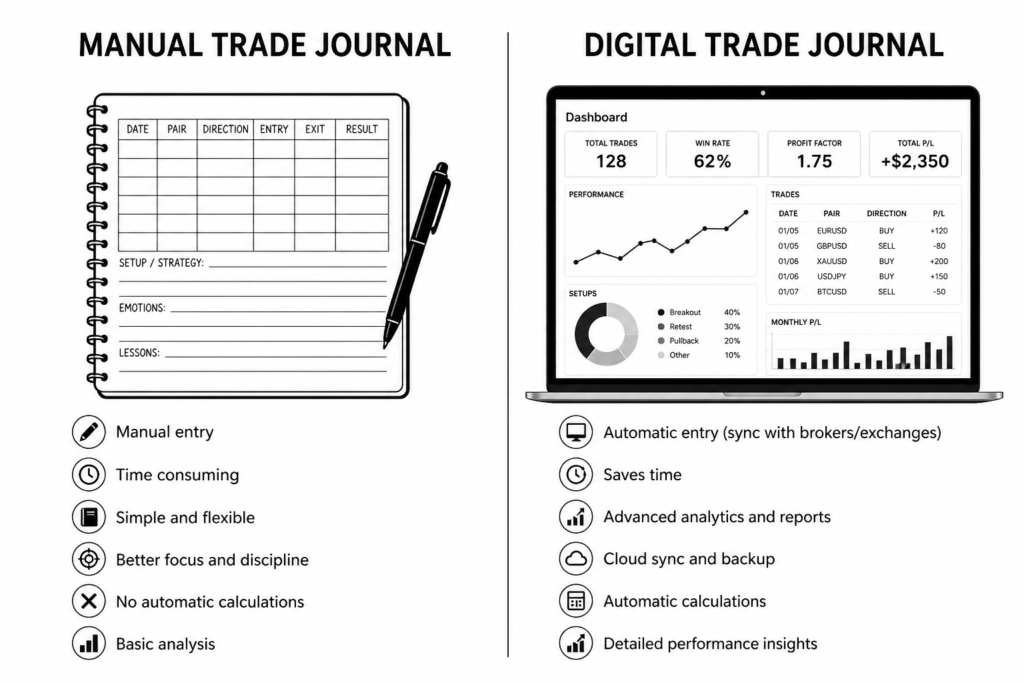
Manual Journals
- Notebook or physical diary
- Helps build discipline and awareness
- Suitable for beginners
Digital Journals
- Spreadsheets, Notion Trading Journal Template or automated platforms
- Faster and more efficient for performance tracking
- Provide detailed analytics and reporting
Modern tools like SuperTrader.me, Tradersync or Tradezella act as advanced performance tracking tools by automatically importing trades, generating reports, and helping traders perform deep trading performance analysis. This reduces manual effort and allows traders to focus more on strategy improvement.
In simple terms, a trading journal is not just a logbook. It is a powerful system that helps you understand your trading behavior, refine your strategy, and move toward consistent, data-driven results.
Why is a Trading Journal Important?
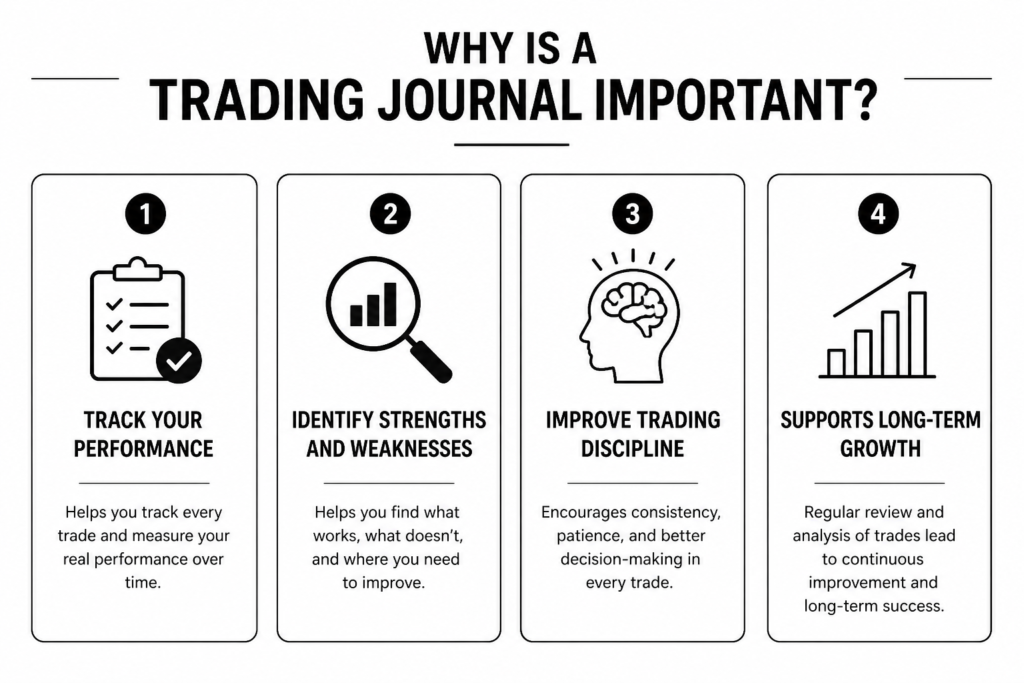
A trading journal is one of those things most traders ignore at the start… and later regret not using earlier. It’s not just about writing down trades, it’s about understanding your behavior, improving your decisions, and building real trading discipline.
Improves Trading Psychology
Let’s be honest, trading is heavily emotional. Fear, greed, hesitation, overconfidence… they all affect your decisions. A trading journal helps you track these emotions and improve your emotional control in trading.
When you review your trades, you start noticing patterns like:
- Entering trades too early
- Taking trades out of FOMO
- Not following your plan
Tools like Edgewonk can even highlight these patterns for you, making your trading behavior analysis much easier and more effective.
Helps You Stop Repeating Mistakes
Without a journal, you’ll keep making the same mistakes without even realizing it. A trading journal shows you exactly where things are going wrong.
For example:
- Not respecting stop loss
- Overtrading in one session
- Taking random entries without a setup
Once you see these patterns clearly, it becomes much easier to fix them.
Builds Accountability and Discipline
When you know every trade will be recorded, you naturally become more careful. This builds strong risk management discipline over time.
You start asking yourself:
- Does this trade follow my plan?
- Is this setup actually valid?
Platforms like Myfxbook make this even easier by automatically tracking your trades and giving you performance insights.
Helps You Improve Your Strategy Over Time
The biggest advantage is that you stop guessing and start relying on data. Your trading decisions become more structured and logical.
You can clearly see:
- Which strategies are working
- Which ones are failing
- What works best in different market conditions
This is where real trading performance analysis happens, and it’s what helps you move toward consistent results.
Benefits of Using a Trading Journal
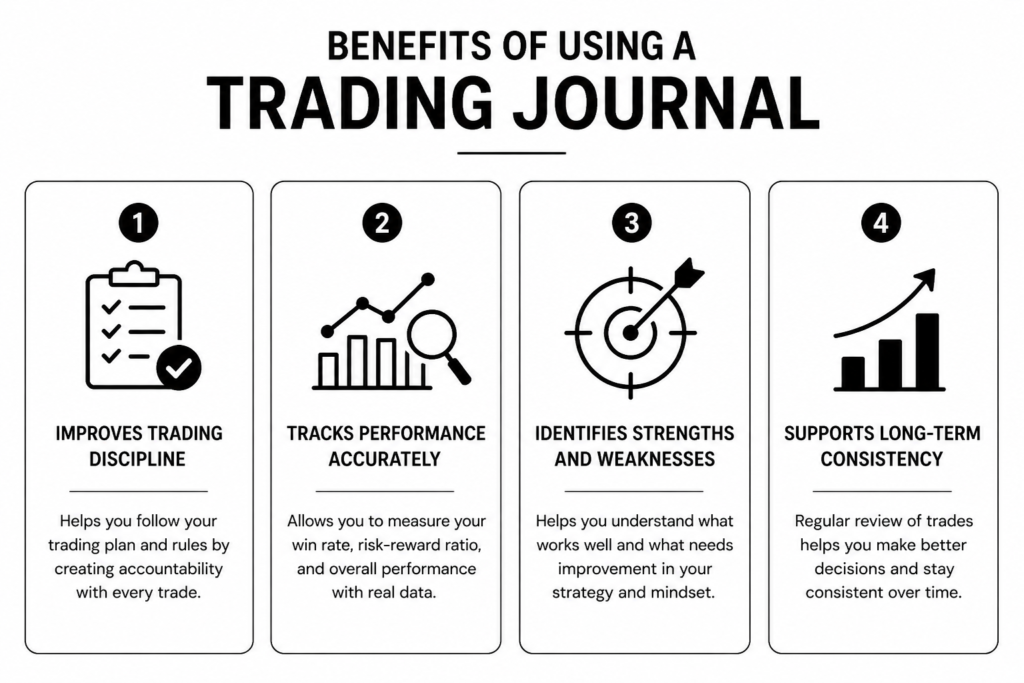
A trading journal is not just about recording trades, it’s about improving how you trade over time. When you consistently track and review your trades, you start making smarter, more data-driven trading decisions instead of relying on guesswork.
Identify Winning and Losing Patterns
One of the biggest advantages of a trading journal is that it helps you clearly see what’s working and what’s not.
Over time, you’ll notice patterns like:
- Which setups give you consistent profits
- Which trades usually lead to losses
- Which market conditions suit your strategy
Improve Consistency in Trading
Consistency is what separates profitable traders from struggling ones. A trading journal helps you build that consistency by showing you whether you are actually following your plan or not.
When you review your trades regularly, you start developing better habits and stronger trading consistency building, which leads to more stable results over time.
Control Fear and Greed
Emotions like fear and greed are responsible for most trading mistakes. A journal helps you track your emotional state during trades, making you more aware of your behavior.
For example, you might realize:
- You exit trades too early due to fear
- You hold losing trades too long greed
Improve Risk-to-Reward Management
A trading journal helps you evaluate whether your trades have a proper risk-to-reward ratio. You can easily see if you are risking too much for too little reward.
By tracking this data, you start improving your risk management strategy, which is essential for long-term survival in trading.
Make Better Decisions Using Data
The biggest benefit is that your decisions become logical instead of emotional. You stop guessing and start relying on actual performance data.
With consistent journaling, you can:
- Analyze your win rate
- Measure your average risk-to-reward
- Track your overall performance
This leads to smarter, more confident data-driven trading decisions and continuous trading performance improvement.
Key Elements of a Trading Journal (What to Record)
A trading journal is only useful if you record the right information. Random notes won’t help, you need a clear trade tracking structure that captures everything important about your trades.
Think of it as building your own trading analysis system, where every trade gives you data to improve your strategy, discipline, and decision-making.
Basic Trade Data
This is the foundation of your journal. It includes all the core details of your trade.
You should always record:
- Entry price and exit price
- Lot size or position size
- Asset or trading pair (e.g., EUR/USD, Gold)
- Date and time of the trade
This data helps you track your performance and calculate key metrics like win rate and profit/loss.
Strategic Data
This is where you record the “why” behind your trade. Most traders skip this part, but this is what actually improves your strategy.
Include:
- Trade setup (breakout, support/resistance, trend, etc.)
- Strategy used
- Stop loss (SL) and take profit (TP) levels
- Risk-to-reward ratio
By tracking this, you can later analyze which setups work best.
This is a key part of risk management tracking, because it shows whether you are taking smart trades or just random entries.
Psychological Data
This is the most underrated part of a trading journal, but also the most powerful.
You should record:
- Your emotions during the trade (fear, greed, FOMO, confidence)
- Whether you followed your trading plan or not
- Any mistakes or impulsive decisions
From real experience, this is where most improvement comes from. Traders often realize that their biggest losses are not due to strategy, but due to poor trading psychology.
Why These Elements Matter
When you combine:
- Basic data
- Strategy data
- Psychological data
You create a complete trading analysis system
This allows you to:
- Identify patterns in your trades
- Improve your strategy
- Build strong discipline
- Make better data-driven trading decisions
Types of Trading Journals
There is no single best way to keep a trading journal. Different traders use different trade tracking methods depending on their experience level, budget, and workflow. The goal is always the same: build a strong system for performance tracking and trading analysis.
1. Manual Journal (Notebook Method)
This is the simplest method where you write everything by hand in a notebook or diary.
Pros
- Very simple and beginner-friendly
- Builds strong trading discipline
- Improves focus and awareness of decisions
- No technical setup required
Cons
- Time-consuming
- No automatic calculations or reports
- Hard to analyze long-term performance
- Easy to lose or mismanage data
Best For
- Complete beginners who are just starting trading
- Traders who struggle with discipline and want to slow down their decision-making
- People who want to improve trading psychology and awareness first before using tools
2. Spreadsheet Journal (Excel / Google Sheets / Notion)
This is a more structured and flexible method where you manage trades digitally using spreadsheets or tools like Notion.
Pros
- Fully customizable trade tracking structure
- Free or low cost
- Easy to calculate profit/loss and risk-to-reward
- Can combine trades, notes, and strategy in one place
- Good balance between manual control and structure
Cons
- Requires setup and learning time
- No automatic trade import
- Can become messy if not organized properly
- Limited performance analytics tools compared to advanced software
Best For
- Beginner to intermediate traders
- Traders who want full control over their journal system
- People who enjoy customizing their workflow
- Traders focusing on improving risk management tracking and strategy building
3. Automated Trading Journal Software
This is the most advanced option where platforms automatically import and analyze your trades.
Popular tools include SuperTrader.me, Tradervue, Edgewonk, and Tradezella.
Pros
- Automatic trade tracking and import
- Advanced performance analytics tools
- Detailed reports (win rate, drawdown, risk metrics)
- Saves time and reduces manual effort
- Strong trading analysis system for deep insights
Cons
- Paid tools (subscription cost)
- Less flexible than custom spreadsheets
- Can feel complex for beginners
- Risk of over-relying on software instead of understanding trades
Best For
- Intermediate to advanced traders
- Traders who are already consistent and want to scale performance
- People focused on data-driven trading performance improvement
- Traders who want deep statistical analysis of their strategy
Which One Should You Choose?
Each method fits a different stage of a trader’s journey: read how to choose trading journal here.
- Beginner → Start with notebook or spreadsheet
- Intermediate → Use Excel, Google Sheets, or Notion
- Advanced → Switch to automated tools like SuperTrader.me or Tradervue
The key is not which tool you choose, but how consistently you use it. A simple journal used properly will always outperform a complex system that you don’t follow.
How to Start a Trading Journal (Step-by-Step)
Starting a trading journal is not complicated, but doing it consistently is what really matters. The goal is to build a simple trading system setup that you can actually maintain every day without overthinking.
1. Choose Your Platform
The first step is to decide where you will keep your journal.
You can choose:
- Manual notebook (for simplicity and discipline)
- Spreadsheet tools like Excel or Google Sheets
- Notion for an organized digital system
- Advanced tools like Edgewonk, SuperTrader.me or Tradervue
The best platform is the one you can actually use daily without skipping.
2. Create a Structured Template
Before you start trading, set up a simple structure for recording trades.
Your template should include:
- Entry and exit details
- Trade size and asset
- Strategy used
- Stop loss and take profit
- Emotional notes
A clear structure makes your trading system setup more organized and easy to follow.
3. Record Every Trade Consistently
This is the most important rule.
You must record:
- Every winning trade
- Every losing trade
- Every missed opportunity (if possible)
Consistency is the foundation of trading discipline building. Without this step, your journal has no real value.
4. Add Emotional + Strategic Notes
Don’t just record numbers. Also write what was happening in your mind during the trade.
Include:
- Fear, greed, FOMO, or confidence
- Whether you followed your trading plan
- Any impulsive decisions
This helps you understand your trading psychology and improve decision-making over time.
5. Weekly or Monthly Review Process
This is where real improvement happens.
Review your trades and check:
- What strategies are working
- Where you are losing money
- Emotional mistakes you keep repeating
This performance review process is what turns raw data into meaningful insights.
6. Adjust Your Trading Strategy Based on Data
After reviewing your journal, make small improvements to your strategy.
For example:
- Avoid setups that consistently lose
- Focus more on high win-rate strategies
- Improve risk-to-reward ratio
Final Takeaway
Starting a trading journal is simple, but the real power comes from consistency.
If you:
- Set up a simple system
- Record every trade
- Review regularly
Then your journal becomes a powerful tool for improving discipline, strategy, and long-term trading results.
How to Analyze Your Trading Journal
Recording trades is only half the job. The real value of a trading journal comes when you start analyzing it properly. This is where you turn raw data into meaningful insights and improve your overall trading performance analysis.
Win Rate Analysis
Start by checking your win rate. This simply means how many trades you are winning compared to losing.
Ask yourself:
- How many trades are profitable?
- Is my win rate consistent over time?
- Am I improving or getting worse?
This helps you understand whether your strategy is actually working or not as part of your trade evaluation system.
Risk-to-Reward Evaluation
Next, analyze your risk-to-reward ratio.
Look at:
- How much you are risking per trade
- How much you are earning on winning trades
- Whether your reward justifies your risk
Even with a lower win rate, good risk management can keep you profitable. This is a key part of data analysis in trading.
Identifying Losing Patterns
One of the most important steps is finding patterns in your losses.
For example:
- Are you losing during specific market conditions?
- Do you enter trades too early or too late?
- Are certain setups always failing?
Tools like Edgewonk help highlight these patterns clearly so you can improve your decision-making process.
Emotional Behavior Tracking
Trading is not just technical, it’s also emotional. Your journal should show how you behave during trades.
Check for:
- Fear-based exits
- Greed-driven overholding
- FOMO entries
- Revenge trading
Understanding these patterns improves your trading psychology and helps you stay more disciplined over time.
Strategy Performance Measurement
Finally, evaluate your trading strategies.
Ask:
- Which strategy gives the best results?
- Which setups are consistently profitable?
- Which ones should be avoided?
Common Trading Journal Mistakes
Even a good trading journal loses its value if it is not used properly. Many traders start journaling but still fail to improve because they make some common trading journal mistakes.
Recording Only Profitable Trades
One of the biggest mistakes is only writing winning trades and ignoring losses.
This creates a false picture of performance because:
- You don’t see real weaknesses
- You repeat the same losing mistakes
- Your trade tracking system becomes incomplete
A proper journal must include every trade, whether it is profit or loss.
Inconsistent Journaling
Another common issue is inconsistency. Traders often start strong but stop after a few days or weeks.
This leads to:
- Missing important data
- Incomplete analysis
- Weak performance tracking issues
Consistency is what makes a trading journal useful, not perfection.
No Regular Review Process
Just recording trades is not enough. Many traders never review their journal.
Without review:
- You cannot identify patterns
- You don’t improve your strategy
- You miss key learning opportunities
Ignoring Emotional Data
Most traders only focus on numbers and ignore emotions. This is a major mistake.
You should always track:
- Fear during entry or exit
- Greed in holding trades too long
- FOMO entries
- Revenge trading behavior
Ignoring this part weakens your understanding of trading psychology and leads to repeated mistakes.
Best Trading Journal Tools (Recommended)
Choosing the right tool can make your trading journal much more powerful and easier to maintain. These platforms help you improve trading analytics, track performance, and build a structured trade tracking system.
1. SuperTrader
SuperTrader is a modern trading journal and performance tracking platform designed for traders who want a simple but powerful system.
It helps with:
- Trade recording and analysis
- Performance tracking in one place
- Building better trading discipline over time
It is especially useful for traders who want a clean and easy-to-use trading journal software without overcomplicated features.
2. Tradervue
Tradervue is a popular platform known for its detailed trade analysis features.
It offers:
- Advanced trade tagging and journaling
- Performance breakdowns
- Strategy evaluation tools
It is widely used for improving trading performance analysis and identifying strengths and weaknesses in your trading system.
3. Edgewonk
Edgewonk is a powerful journal that combines trading statistics with psychological tracking.
It helps traders:
- Track emotions like fear, greed, and discipline
- Analyze performance patterns
- Improve decision-making using data
It is one of the best performance tracking tools for traders focused on both psychology and strategy.
4. TradeZella
TradeZella is a modern automated trading journal designed for traders who want clean analytics and simple performance tracking.
It provides:
- Automatic trade importing
- Clear performance dashboards
- Easy trade review and analysis
It is ideal for traders looking for a user-friendly trading analytics platform with strong automation features.
5. TraderSync
TraderSync is a professional-grade trading journal that focuses on deep performance analytics.
It includes:
- Detailed trade reports and charts
- Advanced filtering and tagging
- Performance tracking across strategies
It is great for traders who want serious performance tracking tools for scaling their trading.
6. Trademetria
Trademetria is a simple yet effective trading journal platform designed for both beginners and intermediate traders.
It offers:
- Easy trade logging system
- Portfolio and performance tracking
- Basic but useful analytics
It is suitable for traders who want a lightweight trading journal software without complexity.
Trading Journal Templates (Free Options)
If you’re just getting started, you don’t need expensive tools. A simple free trading journal template is more than enough to build consistency and improve your trading habits. The goal is to start tracking your trades properly using a basic trade log sheet or structured system.
1. Excel Trading Journal Template
An Excel-based journal is one of the most common starting points for traders.
It allows you to:
- Record every trade in a structured way
- Calculate profit/loss automatically
- Track risk-to-reward ratios
- Build a simple trading tracker spreadsheet
This is ideal for traders who want full control over their data and prefer offline tracking.
2. Google Sheets Tracker
A Google Sheets journal is similar to Excel but more flexible because it works online.
Key benefits:
- Access from anywhere (mobile or PC)
- Easy sharing and backup
- Real-time updates
- Custom formulas for performance tracking
It is one of the most popular trade log sheet solutions for modern traders who want convenience and flexibility.
3. PDF Printable Journal
A PDF trading journal is a simple, printable version of a trading log.
It is useful for:
- Traders who prefer writing by hand
- Daily or weekly trade reviews
- Improving focus and discipline without distractions
This method supports strong trading discipline building because it forces you to slow down and manually record each trade.
Trading Journal vs No Trading Journal
The difference between traders who use a journal and those who don’t is huge. It’s not just about record keeping, it directly affects your trading consistency difference, decision-making, and long-term results.
Structured Trading vs Emotional Trading
When you use a trading journal, your trading becomes structured and planned.
You start:
- Following a clear strategy
- Recording every trade
- Learning from past mistakes
Without a journal, trading is mostly emotional. Decisions are often based on:
- Fear of missing out (FOMO)
- Greed for quick profits
- Random market reactions
This creates inconsistency and reduces overall performance.
Data-Driven Decisions vs Guesswork
A trading journal turns your trading into a disciplined trading system based on real data.
With a journal, you:
- Analyze past trades
- Understand what works and what doesn’t
- Make decisions based on evidence
Without it, traders rely on guesswork:
- This setup feels good
- Market might reverse here
- No proper validation of strategy
This creates a clear trading performance gap between disciplined and undisciplined traders.
Why the Difference Matters
Over time, the gap becomes even bigger:
- Journal users improve consistently through data-driven trading decisions
- Non-journal users repeat the same mistakes
- One builds structure, the other stays random
Simply put, a trading journal transforms trading from gambling into a proper disciplined trading system.
Pro Tips for Better Results
A trading journal only works when you actually use it properly and consistently. These simple habits can significantly improve your trading improvement strategy and overall performance over time.
Daily Journaling Habit
Make it a rule to record every trade on the same day it happens. Don’t delay it, because details fade quickly.
Focus on:
- Entering trades immediately after execution
- Recording emotions while they are still fresh
- Keeping data accurate and complete
This habit is the foundation of strong trading habit building.
Weekly Review Discipline
Set a fixed time every week to review your trades.
During review:
- Analyze winning and losing trades
- Check your mistakes and patterns
- Evaluate if you followed your strategy
Keep the System Simple
Don’t overcomplicate your journal.
A simple structure is always better than a complex system you stop using. Focus on:
- Essential trade data
- Basic strategy notes
- Emotional tracking
Simplicity leads to consistency, and consistency leads to better performance optimization.
Focus on Consistency Over Perfection
Many traders try to build a “perfect” journal and give up when it becomes too complicated. Instead, aim for consistency.
Remember:
- A simple journal used daily is powerful
- A perfect system used rarely is useless
The goal is progress, not perfection.
Conclusion
A trading journal is not just a record-keeping tool, it’s a combination of mindset + system that shapes how you think and act as a trader.
When you consistently use a journal, you slowly build a strong trading discipline system that keeps your decisions structured instead of emotional.
The real importance lies in consistency. You don’t become a better trader in one week it’s the daily habit of recording, reviewing, and learning that leads to real improvement.
Over time, this process develops a strong trading mindset development, where you start thinking in terms of data, probability, and risk instead of emotions and guesswork.
In the long run, traders who stick with journaling achieve more stable and consistent trading growth, while others keep repeating the same mistakes.
Simply put, success in trading is not just about strategy, it’s about discipline, awareness, and consistency built through a trading journal.
FAQ Section
This section answers some common trading journal guide questions that beginners and intermediate traders usually have. These beginner trading system FAQs will help you clear confusion and start journaling with more confidence.
Is a trading journal necessary?
Yes, a trading journal is highly important if you want long-term consistency. It helps you track your trades, improve your strategy, and understand your mistakes. Without it, trading becomes emotional and random instead of structured.
What is the best trading journal software?
There is no single “best” tool, but popular options include SuperTrader.me, Edgewonk, Tradervue, and Myfxbook. These platforms offer advanced analytics, performance tracking, and detailed trade analysis features.
How often should I update my trading journal?
Ideally, you should update your journal after every trade. If that’s not possible, then at least update it daily. The more consistent you are, the more accurate your trading performance analysis will be.
Excel vs software tools which is better?
Both have their advantages:
- Excel is simple, flexible, and free, making it great for beginners
- Advanced tools like SuperTrader or Tradervue offer automation and deeper analytics
If you are starting, Excel is enough. As you grow, switching to trading journal software can improve your efficiency and analysis.