A trading journal is the structured system traders use to record, review, and improve their trading decisions. It is where a trade enters as a raw transaction and exits as a performance data point that either confirms a strategy is working or surfaces the patterns behind why it is not. But not all trading journals are built the same way. The differences across tools available in 2026 are significant enough to determine whether a trader gets genuine improvement feedback from their review process or ends up with an incomplete record that tells them little beyond what their broker statement already shows. Automation capability, analytics depth, asset class support, and pricing vary considerably across the tools in this category, and those differences matter in ways that become apparent only after a trader has committed to a journaling workflow and discovered where their chosen tool falls short.
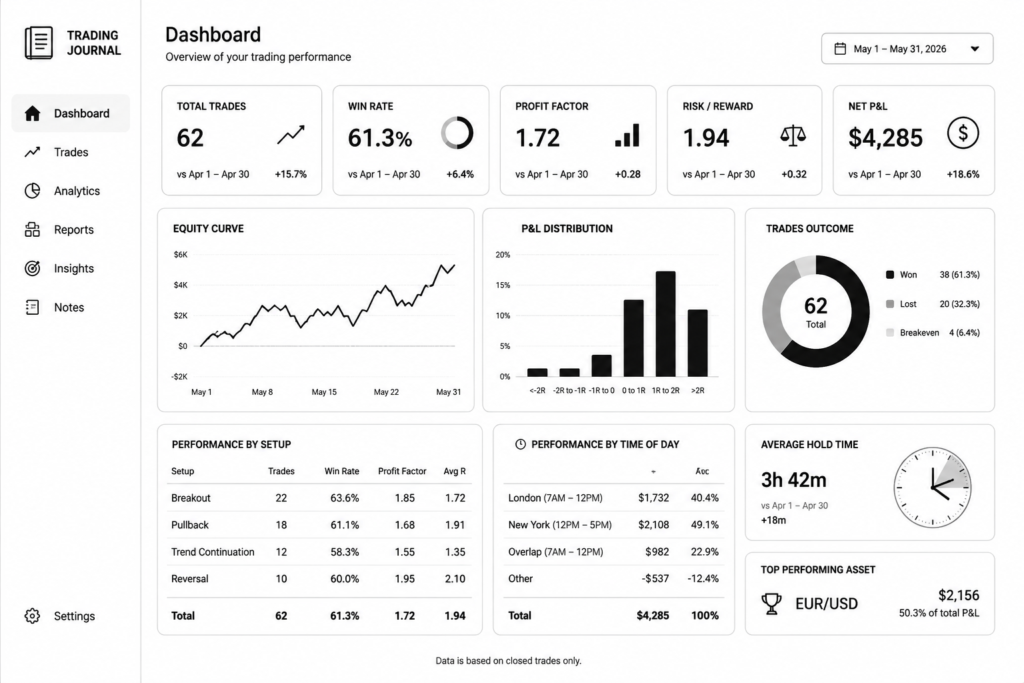
Choosing the wrong trading journal does not just produce a suboptimal experience. It actively slows down the improvement cycle that separates consistently profitable traders from those who repeat the same mistakes across months and years of trading. A journal that requires excessive manual entry creates friction that causes most traders to abandon the habit within weeks. A journal that tracks trades without producing meaningful performance analysis gives a trader data without insight. A journal that does not support the trader’s primary asset class correctly produces metrics that are either inaccurate or incomplete, making the review process unreliable regardless of how consistently it is used. The right journal is not the most popular one, the most heavily marketed one, or the one with the longest feature list. It is the one that fits the trader’s specific asset class, experience level, and analytical needs closely enough to become a sustainable part of their trading process.
The evidence behind consistent journaling as a performance driver is clear. Traders who journal consistently outperform those who do not by a significant margin across multiple studies examining the relationship between structured trade review and profitability improvement. The mechanism is straightforward: journaling makes patterns visible that are invisible inside a trader’s memory of individual trades, and visible patterns can be acted on in ways that invisible ones cannot. What the research also shows is that manual journaling produces significantly higher dropout rates than automated import-based journaling, because the friction of recording every trade by hand is enough to break the habit for the majority of traders who attempt it. The automation gap between tools is therefore not a convenience distinction. It is the primary determinant of whether a trader actually journals consistently enough for the data to be meaningful. The trading journal software market has expanded considerably in 2026, with new entrants and significant feature updates across established platforms creating meaningful differences in what each tier of tool delivers for the price.
TradingJournalReviews.com exists to make this comparison honest. As an independent review resource, this site evaluates trading journals without affiliate bias, covering real feature depth verified through direct platform use, genuine pricing transparency that reflects what each subscription tier actually delivers rather than what the marketing page implies, and honest assessments of where each tool performs well and where it falls short for specific trader profiles. Every recommendation on this page is based on the same evaluation framework applied consistently across all reviewed tools.
Key Takeaways
- The best trading journal depends entirely on asset class, experience level, and how deeply a trader wants to analyze their performance. There is no single correct answer that applies across all trader profiles.
- Automated broker import capability is the single feature that most directly determines whether a trader uses their journal consistently enough for it to produce meaningful performance improvement over time.
- Free trading journals exist and deliver genuine value for traders building a journaling habit from scratch, but carry significant limitations in analytics depth and automation that constrain the quality of performance insights available at the free tier.
- Paid trading journals range from affordable entry-level subscriptions to premium platforms with pricing that reflects the depth of analytics, breadth of broker integrations, and sophistication of the performance reporting they deliver.
- TradingJournalReviews.com evaluated each tool on a consistent framework covering automation, analytics depth, asset class support, broker integration breadth, user experience, and pricing transparency, so every comparison on this page reflects real differences rather than marketing claims.
What Makes a Trading Journal Worth Using
Automated Import vs Manual Entry
Automated broker import is the single most important feature a trading journal can have, and the reason is not about convenience. It is about whether the journal actually gets used. Manual trade entry requires a trader to sit down after every session, locate every executed trade, record the entry price, exit price, position size, instrument, and any relevant notes, and do this consistently across days, weeks, and months without skipping sessions or falling behind. For traders who execute a handful of trades per week, this is manageable in the short term. For traders who execute dozens of trades per session, it is an unsustainable workflow that breaks down under the first stretch of busy trading days. Studies on journaling habit retention consistently show that manual entry is the primary reason traders abandon their journals within the first month, not lack of motivation or disinterest in performance improvement.
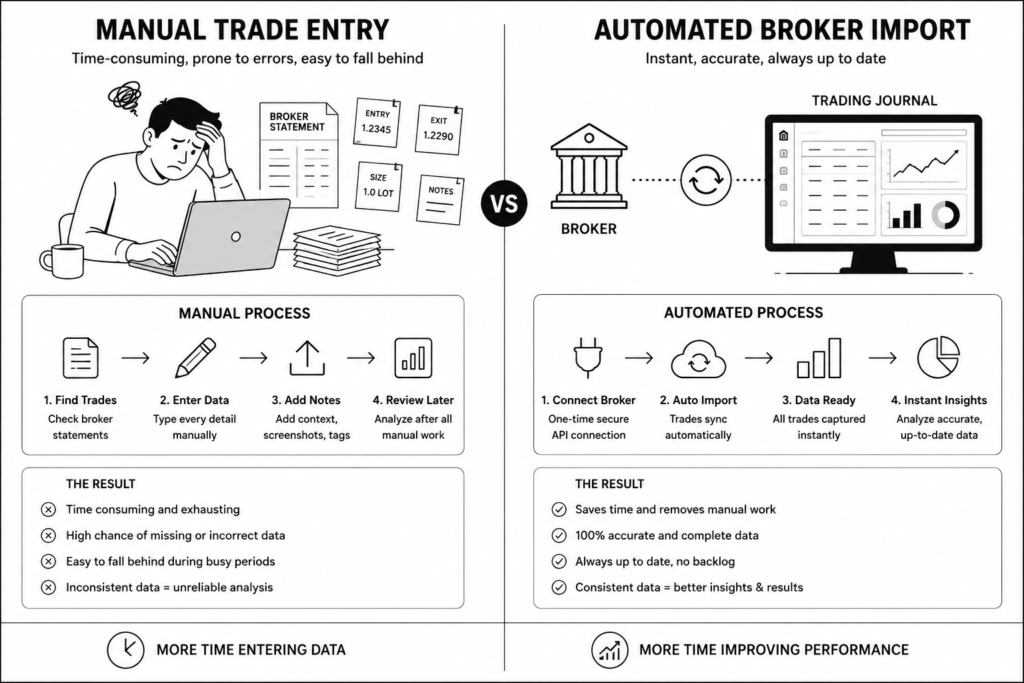
Automated import removes this friction entirely. When a journal connects directly to a broker and pulls executed trades automatically, the recording step disappears from the trader’s workflow. The journal is populated whether the trader remembers to update it or not, which means the data is always current, always complete, and always available for review without the backlog of unrecorded trades that manual journaling accumulates during busy periods.
The distinction between direct API integration and CSV import matters more than most traders realize before they have lived with both. Direct API integration means the journal pulls trade data from the broker in real time or on a scheduled automatic basis with no action required from the trader beyond the initial setup. CSV import means the trader must log into their broker, export a trade history file, and upload it to the journal manually on a regular basis. CSV import is significantly better than fully manual entry, but it still requires a deliberate action from the trader at regular intervals, which is enough friction to cause inconsistency in traders who are not disciplined about the administrative side of their process. The journals that offer direct API integration for the trader’s specific broker eliminate this entirely and deliver the closest thing to a frictionless journaling workflow currently available.
Analytics and Performance Reporting
Win rate and profit and loss are the metrics every trading journal provides and the metrics that tell the least useful story about why a trader’s results look the way they do. Knowing that a strategy wins 55 percent of the time and has produced a net positive return over the past month is the starting point of performance analysis, not the conclusion. The tools that produce real improvement insights go considerably further, and the gap between basic metric tracking and genuine performance analytics is where the meaningful differences between trading journals become visible.
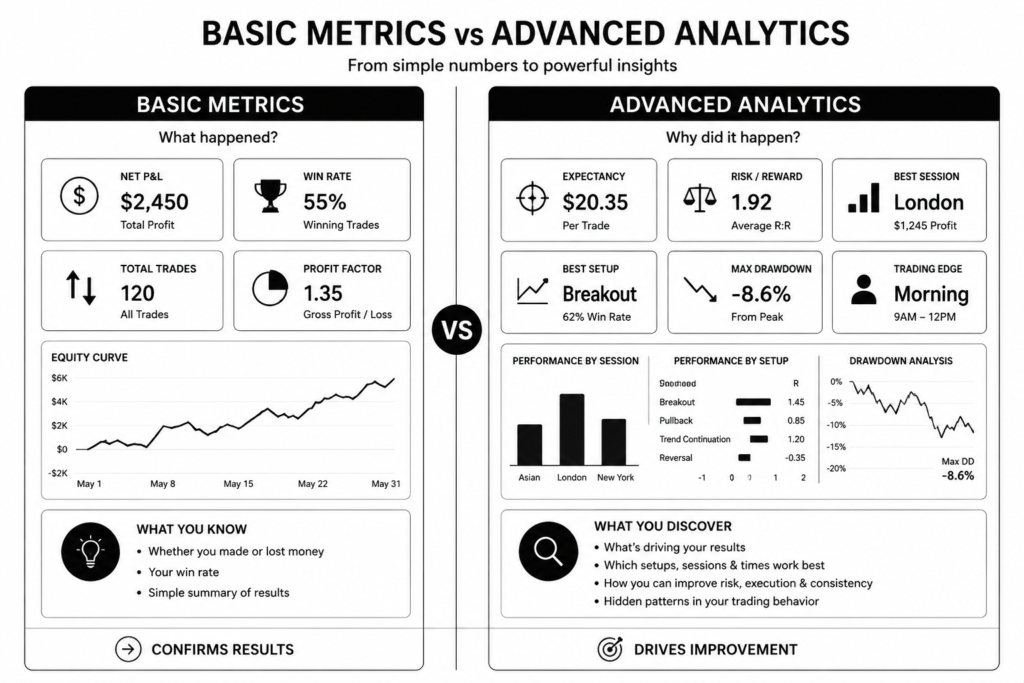
Expectancy is the metric that connects win rate and risk-reward into a single number that tells a trader whether their strategy produces positive results in expectation across a large sample of trades, accounting for both the frequency of winning trades and the average size of wins relative to losses. Risk-reward distribution analysis shows whether a trader is actually executing at the risk-reward ratios their strategy requires or whether position management is systematically compressing the reward side of the equation. Performance by session identifies whether a trader’s edge exists consistently across all trading hours or concentrates in specific market conditions that are not always present. Performance by setup breaks results down by the specific entry criteria that define each trade type, making it possible to identify which setups in a trader’s playbook are producing results and which are diluting overall performance.
Drawdown analysis tracks the depth, duration, and recovery pattern of losing streaks in ways that reveal whether a trader’s risk management is functioning as intended or whether position sizing is creating drawdown exposure that exceeds what the strategy’s historical performance justifies. Behavioral pattern analysis connects non-trading variables — session timing, days of the week, time elapsed since last trade, recent win or loss streaks — to performance outcomes, surfacing the psychological patterns that influence execution quality in ways that pure trade metrics cannot capture alone.
The depth of analytics a journal provides directly determines the quality of the feedback loop a trader can build from their review process. A tool that produces surface-level metrics gives a trader confirmation that results are good or bad without the diagnostic detail required to understand why. A tool that produces deep behavioral and performance analytics gives a trader the specific information needed to make targeted adjustments to their strategy, their execution, and their decision-making process in ways that compound improvement over time.
Asset Class Support
Trading journals are not asset-class-neutral tools, and the assumption that any journal can handle any instrument correctly is one of the most common and costly mistakes traders make when selecting a platform. The underlying data structure required to journal an equity trade, an options position, a futures contract, a forex pair, and a cryptocurrency transaction differs enough across asset classes that journals built primarily for one category frequently handle others poorly, inaccurately, or not at all.
A journal optimized for equities may record options trades as individual legs rather than as unified strategy positions, which means a covered call appears as two separate unrelated trades rather than as a single income-generating strategy with a defined risk profile. A journal built primarily for forex may apply incorrect position sizing logic to futures contracts, producing profit and loss calculations that do not reflect the actual dollar value of contract movements. A journal designed around cryptocurrency trading may lack the tax lot tracking and cost basis methodology options that stock traders require for accurate performance measurement and tax reporting. These are not minor inconveniences. They are fundamental data accuracy problems that make the journal’s performance metrics unreliable for traders in the affected asset classes.
Asset class fit is therefore a non-negotiable filter that should be applied before any other feature comparison begins. A journal that does not correctly support the trader’s primary instrument is not a suboptimal choice. It is not a valid choice at all, regardless of how strong its analytics, automation, or user experience might be for the asset classes it was built to handle.
User Experience and Learning Curve
Feature depth and usability are not the same thing, and a trading journal that scores highly on one does not automatically score highly on the other. The journals with the deepest analytics capabilities are frequently the ones with the steepest learning curves, the most configuration required before the platform delivers useful output, and the most complex interfaces that present performance data in ways that require familiarity with the tool before they become genuinely readable.
For professional traders and advanced practitioners who want maximum customization, the configuration complexity of a feature-rich journal is an acceptable tradeoff. These traders know what metrics they are looking for, understand how to set up custom tags and filters to surface the specific performance dimensions they want to analyze, and have the patience to invest setup time in exchange for the analytical depth the platform delivers once configured correctly. For developing traders who are building a journaling habit for the first time, the same configuration complexity is a barrier that produces abandonment before the journal has had enough time to generate meaningful performance data.
A journal with advanced analytics that requires an hour of setup and maintenance each week will be used less consistently than a simpler tool that integrates into a daily routine in five minutes. And a journal that is used inconsistently produces worse performance insights than a simpler journal that is used every day, because the quality of the feedback loop depends on the completeness of the data more than it depends on the sophistication of the analytics applied to incomplete records. Ease of use is not a secondary consideration that matters only when feature depth is equal across options. It is a primary determinant of whether a trading journal produces the consistent usage that makes any of its features valuable in practice.
How We Evaluate Trading Journals at TradingJournalReviews.com
Every trading journal on the market has a marketing page that describes its features in the most favorable terms available. Integration lists are presented without clarifying which brokers require CSV upload versus which support live API sync. Pricing pages show headline numbers without making clear what the most commonly needed features actually cost at each tier. Analytics capabilities are listed as bullet points without any indication of how useful those analytics are in practice once a trader is actually inside the platform trying to interpret their performance data.
TradingJournalReviews.com was built specifically to cut through this gap between how trading journals present themselves and what they actually deliver. Every review and every recommendation on this site is produced through a consistent evaluation framework applied identically across all tools, so comparisons reflect real differences rather than differences in how well each company’s marketing team describes the same underlying capability.
Feature depth is evaluated against a fixed checklist that covers every capability category relevant to serious trading performance analysis. Automated import, manual entry fallback, trade tagging, setup tracking, note-taking functionality, performance metrics breadth, behavioral analytics, equity curve visualization, drawdown reporting, risk-reward analysis, and export capability are all assessed individually rather than accepted as present based on a feature list claim. A tool that lists “advanced analytics” on its pricing page earns that description in our framework only if the analytics it delivers actually go beyond win rate, profit and loss, and basic trade history filtering.
Pricing transparency is assessed against what each subscription tier actually delivers for the price rather than what the headline number implies. This means identifying which features are locked behind higher tiers, whether the free plan is genuinely functional or exists primarily to frustrate users into upgrading, how the per-month cost compares when billed annually versus monthly, and whether the features that matter most for the tool’s primary use case are accessible at the entry tier or require a premium subscription to unlock. Hidden pricing friction is documented explicitly in every review rather than left for traders to discover after committing to a subscription.
Broker integration breadth is verified through direct confirmation rather than accepted from the integrations page. The number of supported brokers a journal claims on its marketing page frequently differs from the number that support live API sync versus CSV import only, and that distinction determines the quality of the journaling workflow for traders using those brokers. Every integration list in our reviews reflects the actual sync method available for each broker rather than the total count of broker names that appear on the tool’s website.
User experience is assessed through actual platform use across the onboarding process, daily workflow, trade import, and performance review cycle. This means evaluating how long setup takes for a new user, how intuitive the interface is for accessing the metrics that matter most, how clearly performance data is presented without requiring the trader to already understand what they are looking for, and how well the platform holds up under real usage conditions rather than a demo environment designed to present the tool in its best light.
Asset class support is confirmed independently for equities, options, futures, forex, and cryptocurrency rather than accepted as comprehensive based on a general claim of multi-asset support. Each asset class is evaluated on whether the journal handles its specific data requirements correctly, options strategy grouping, futures contract sizing, forex pip calculation, crypto cost basis tracking and any asset class where the tool’s support is incomplete, inaccurate, or limited relative to its marketing claims is documented clearly in the review rather than treated as a minor caveat.
This framework is the foundation that every comparison and recommendation on TradingJournalReviews.com rests on. When this site identifies a tool as the best option for a specific trader profile, that conclusion comes from a consistent evaluation process applied without bias toward any tool, any pricing tier, or any affiliate relationship. The goal is to give traders the honest, specific information they need to make the right choice for their situation rather than the most commercially convenient recommendation available.
Best Trading Journals of 2026: Our Top Picks
Best Overall: SuperTrader
SuperTrader earns the best overall position because it does not force a trader to choose between ease of use and analytical depth. The platform delivers a journaling workflow that works for developing traders without stripping out the performance metrics that serious traders need to make meaningful improvements. Broker import covers the brokers that matter most for active retail traders, the analytics dashboard surfaces performance patterns clearly without requiring configuration expertise to interpret, and the overall experience reflects a platform built by people who understand what traders actually need from a review process rather than what looks impressive on a feature list.
Asset class support covers equities, options, futures, forex, and crypto across all plan tiers rather than gating multi-asset support behind premium subscriptions. Pricing sits at a level that is accessible for traders who are early in their journey and justifiable for traders who are generating consistent results and want the analytical infrastructure to sustain and improve them. For traders who want one platform that handles the full journaling and performance review workflow without requiring a separate tool for any part of the process, SuperTrader is the starting point we recommend before evaluating anything else.
Read our full SuperTrader review for a complete breakdown of features, pricing tiers, broker integration coverage, and how it compares to the closest alternatives.
Best for Day Traders: TraderSync
Day trading places specific demands on a trading journal that most platforms are not built to meet at the level that active intraday traders need. Trade volume is high, sessions move fast, and the performance patterns that determine whether a day trading strategy is working are granular enough that surface-level analytics produce conclusions that are either obvious or misleading. TraderSync is built specifically for the demands of high-frequency intraday trading in a way that no other journal on this list matches.
The broker integration list covers over 700 platforms, which means the automated import workflow functions for virtually every broker an active day trader is likely to use without falling back to CSV upload. The market replay feature operates at 250 millisecond precision, allowing traders to replay past sessions and review execution decisions at the speed those decisions were actually made rather than reconstructing them from static trade data. Session analysis breaks performance down by time of day with the granularity that day traders need to identify whether their edge is consistent across the full session or concentrated in specific market windows. The dedicated iOS and Android apps mean the analytics are accessible between sessions without requiring a desktop setup.
Read our full TraderSync review for a complete breakdown of features, pricing tiers, broker integration coverage, and how it performs for day traders across different asset classes.
Best for Swing Traders: Tradervue
Swing traders hold positions across days and weeks, which means the journaling requirements are fundamentally different from intraday trading. Trade volume is lower, the review process is less time-pressured, and the analytical questions that matter most center on setup quality, multi-day risk management, and the consistency of strategy execution across varying market conditions. Tradervue has been the established platform in this space for years, and the reason is that it delivers the analytical depth swing traders need without the feature complexity that day traders require and swing traders do not.
The platform automatically generates charts around entry and exit points for every trade, which removes the need for traders to take and store screenshots during live market hours. Broker sync covers over 80 platforms with a seamless upload process that works reliably for the brokers swing traders are most likely to use. Performance reporting covers the metrics that matter for multi-day position management, including strategy-level filtering that allows a trader to isolate the results of specific setups across their full trade history and identify which patterns are producing consistent results and which are not. The interface is straightforward enough that the review process does not require significant time investment to produce meaningful analytical output.
Read our full Tradervue review for a complete breakdown of features, pricing tiers, broker sync coverage, and how it compares to the alternatives for swing traders across equity and options markets.
Best for Forex Traders: TradesViz
Forex trading introduces journaling requirements that many platforms handle poorly or incompletely. Pip-based profit and loss calculation, multi-currency account tracking, session analysis across the London, New York, Tokyo, and Sydney market windows, and broker compatibility with the MetaTrader platforms that the majority of forex traders use are all non-negotiable requirements that eliminate several otherwise strong journals from consideration before any other feature comparison begins. TradesViz covers all of these requirements and adds an analytical depth that makes it the strongest dedicated choice for traders whose primary market is forex.
The platform supports MT4 and MT5 integration for automated import, which covers the broker infrastructure that the majority of active forex traders operate on. Session analysis breaks performance down across the major forex market hours with the granularity required to identify whether a trader’s edge is session-specific or consistent across the full trading day. Multi-currency tracking handles the account denomination complexity that forex traders face when trading pairs across different currency bases. The analytics suite covers over 600 statistics at the paid tier, giving forex traders the depth of performance data required to identify the subtle patterns that determine whether a forex strategy is genuinely profitable or benefiting from favorable market conditions that will not persist.
Read our full TradesViz review for a complete breakdown of features, pricing tiers, forex-specific integration coverage, and how it handles multi-currency performance analysis across the major and minor pairs.
Best for Options Traders: Trademetria
Options trading is the asset class that exposes the limitations of generic trading journals most quickly. A journal that records each leg of a multi-leg options position as a separate trade produces performance data that is structurally incorrect — a covered call is not two unrelated trades, and analyzing it as such produces metrics that do not reflect the actual risk and return profile of the strategy. Trademetria is the strongest journal in the sub-$30 per month tier for options traders specifically because it handles the data architecture of options trading correctly from the ground up.
Spread merging groups multi-leg positions into unified strategy records automatically, meaning a vertical spread, iron condor, or covered call appears in the analytics as the single strategy it represents rather than as a collection of disconnected legs. Strategy-level reporting shows performance broken down by options strategy type, allowing traders to identify which specific structures are producing results and which are not. Real-time Greeks tracking and implied volatility data are integrated into the trade record, giving options traders the contextual data alongside their performance metrics that a purely price-based journal cannot provide. Asset class coverage extends across equities, options, futures, forex, crypto, and CFDs on all plan tiers including the free plan.
Read our full Trademetria review for a complete breakdown of features, pricing tiers, broker integration coverage, and how it handles options analytics compared to the alternatives in this category.
Best Free Trading Journal: TradesViz
The free trading journal category is populated by options that range from genuinely useful to marketing exercises designed to frustrate traders into upgrading as quickly as possible. TradesViz sits at the far end of the genuinely useful spectrum. The free tier provides 3,000 trade executions per month, access to over 600 statistics, AI question and answer functionality, and CSV import support across a broad range of broker formats. For swing traders and moderate-volume traders, the free tier is sustainable indefinitely without hitting a cap that forces an upgrade. For active traders who execute several hundred trades per month, it remains functional for significantly longer than any competing free option before volume limits become a constraint.
The analytics available on the free tier go considerably beyond what most paid journals at the entry subscription level deliver, which makes TradesViz the only free journal on this list that functions as a genuine performance analysis tool rather than a trade log with basic metrics attached. The interface prioritizes data density over visual polish, which means there is a learning curve for traders who are new to dedicated journaling platforms, but the analytical output once the platform is configured rewards the setup investment with a depth of performance insight that free tools in other software categories rarely approach.
Read our full TradesViz review for a complete breakdown of the free tier limitations, what the paid plans add, broker integration coverage, and how the analytics depth compares to paid alternatives at similar price points.
Best for Beginners: TradeZella
Traders who are building a journaling habit for the first time need a platform that produces clear, actionable feedback without requiring them to already understand advanced performance metrics to interpret what the journal is telling them. TradeZella is built around this requirement more deliberately than any other platform on this list. The onboarding process is guided, the analytics are presented in a visually accessible format that makes performance patterns immediately readable, and the platform’s community features provide the accountability and context that traders who are new to structured review benefit from during the early stages of building the habit.
The Zella Score gives traders a single top-level performance indicator that surfaces the most important areas for improvement without requiring them to navigate a dense analytics dashboard to identify where their trading process is breaking down. Trade replay functionality allows beginners to review their execution decisions visually rather than reconstructing them from numbers alone, which produces a more intuitive understanding of what went wrong and what went right in each session. Backtesting support lets developing traders test strategy ideas against historical data before risking capital, which is a particularly valuable feature for traders who are still in the process of identifying a strategy worth committing to. Broker integration covers over 500 platforms with automated sync that removes the manual entry friction that causes most beginners to abandon journaling before the habit is established.
Read our full TradeZella review for a complete breakdown of features, pricing tiers, broker integration coverage, and how it compares to the alternatives for traders who are building their journaling practice from the ground up.
Trading Journal Comparison Table
The table below covers every tool reviewed on TradingJournalReviews.com across the criteria that matter most for making a confident purchase decision. Pricing reflects the most commonly used paid tier. Analytics depth is rated on a five-point scale based on our evaluation framework. Overall rating reflects the TradingJournalReviews.com assessment across all criteria combined.
| Tool | Starting Price | Free Tier | Broker Integrations | Asset Classes | Auto Import | Analytics Depth | Mobile App | Our Rating |
| SuperTrader | TBC | TBC | TBC | Stocks, Options, Futures, Forex, Crypto | Yes | 5/5 | Yes | 5/5 |
| TraderSync | $29.95/mo | Limited (10 trades/mo) | 700+ | Stocks, Options, Futures, Forex, Crypto, CFDs | Yes | 4.5/5 | Yes (iOS + Android) | 4.5/5 |
| Tradervue | $29/mo | Yes (100 trades/mo) | 80+ | Stocks, Options, Futures, Forex | Yes | 4/5 | No | 4/5 |
| TradesViz | $19.99/mo | Yes (3,000 trades/mo) | 200+ | Stocks, Options, Futures, Forex, Crypto | Yes | 4.5/5 | No (PWA only) | 4.5/5 |
| Trademetria | $13/mo | Yes (30 orders/mo) | 140+ | Stocks, Options, Futures, Forex, Crypto, CFDs | Yes (select brokers) | 4/5 | No (mobile web) | 4/5 |
| TradeZella | $29/mo | No (7-day trial) | 500+ | Stocks, Options, Futures, Forex, Crypto | Yes | 4/5 | No (mobile web) | 4/5 |
| JournalPlus | $159 one-time | No | 700+ | Stocks, Options, Futures, Forex, Crypto | Yes | 4.5/5 | No | 4/5 |
Notes on the table:
Each tool name in the table links to its full review on TradingJournalReviews.com where pricing, broker integration lists, asset class support, and analytics depth are covered in detail based on direct platform evaluation rather than marketing page claims.
How to Choose the Right Trading Journal for Your Needs
The comparison table and category recommendations above narrow the field considerably, but the right trading journal for any individual trader depends on three variables applied in a specific sequence. Applying them out of order produces a shortlist that looks reasonable on paper but fails in practice because it optimizes for the wrong criteria first. Asset class comes first.
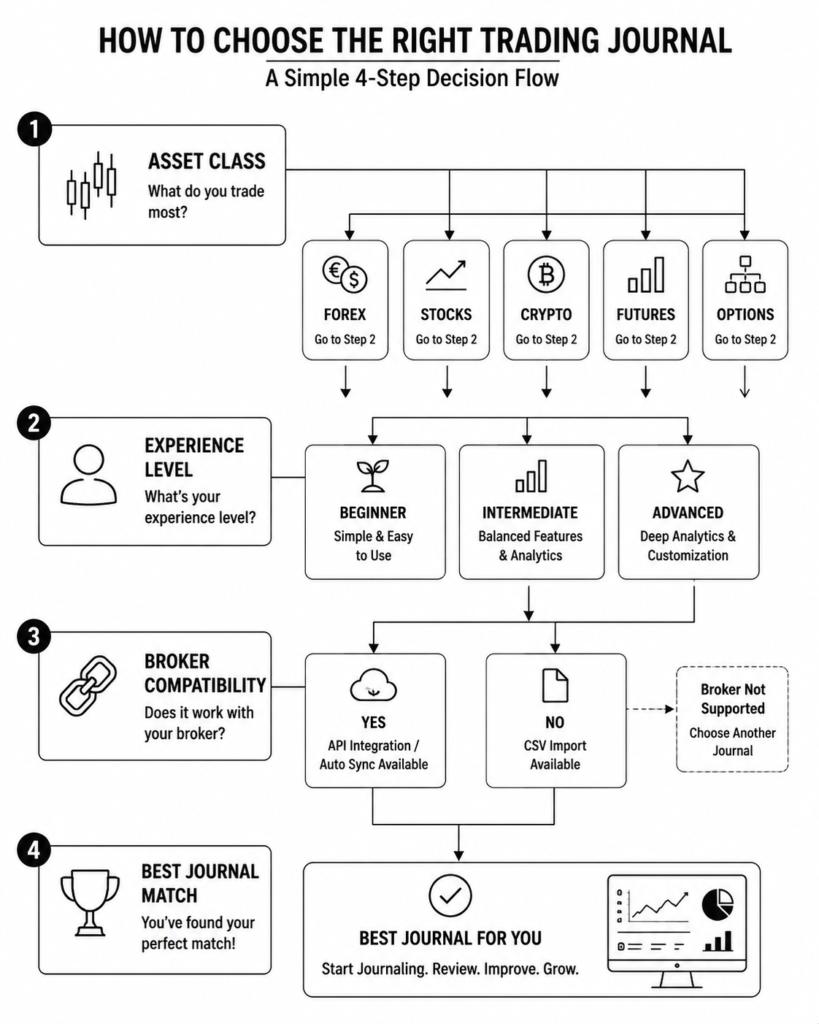
Experience level comes second. Broker compatibility comes third. Working through these three filters in order eliminates the journals that cannot serve a trader’s specific situation before time is spent evaluating features that would never be used or analytics that would never be accessible.
Choose Based on Asset Class First
Asset class is the non-negotiable filter that determines which journals are viable options and which are not, regardless of how strong their feature set looks in every other category. A journal that does not correctly support a trader’s primary instrument produces inaccurate performance data, and inaccurate performance data produces conclusions that lead to worse trading decisions rather than better ones. The first question any trader should ask before evaluating any other feature is whether the journal handles their specific asset class correctly at the data architecture level, not just whether it lists that asset class on the integrations page.
Options traders need a journal that groups multi-leg positions into unified strategy records rather than recording each leg as a separate trade. Without spread merging, a two-leg vertical spread appears as two unrelated trades in the analytics, which makes win rate calculations meaningless and profit and loss attribution structurally incorrect. Before evaluating anything else, options traders should confirm that spread merging is available and that strategy-level reporting breaks performance down by options structure rather than by individual contract.
Forex traders need a journal that calculates profit and loss in pip terms rather than dollar terms only, that tracks performance across the major session windows rather than applying a single daily performance view, and that supports the MetaTrader platforms that the majority of forex brokers operate on. A journal that covers equities and options comprehensively but handles MT4 import through a cumbersome manual process is not a strong forex journal regardless of how deep its analytics are for the asset classes it was built around.
Futures traders need correct contract sizing logic that translates tick movements into dollar profit and loss accurately for the specific contracts being traded. A journal that applies generic position sizing calculations to futures trades produces equity curve data that does not reflect actual account performance, which makes every downstream analytical output unreliable. Confirming that the journal handles the specific futures contracts a trader uses, including micro contracts and options on futures where applicable, is the foundational check before any other evaluation begins.
Equity traders have the widest range of compatible journals available because equities are the asset class most trading journals were originally built around. The primary filter for equity traders is not asset class compatibility but the secondary criteria of experience level and broker compatibility, since most journals on this list handle stock trading correctly at the data level.
Choose Based on Experience Level Second
Once asset class compatibility has narrowed the field to journals that can handle a trader’s instruments correctly, experience level determines which of the remaining options delivers the right analytical depth for where a trader currently is in their development. The mismatch between experience level and analytics depth is one of the most common reasons traders abandon their journals within the first few months, either because the platform overwhelms them with metrics they do not yet know how to use, or because it produces output that is too surface-level to generate the insights a more advanced trader needs to continue improving.
Beginning traders benefit most from journals that present performance data in a clear, accessible format that surfaces the patterns most likely to be producing losses without requiring the trader to already know what to look for. Win rate, average risk-reward ratio, consistency of position sizing, and performance by day of week are the metrics that reveal the most obvious improvement opportunities for traders who are early in their development. A journal that delivers these metrics clearly and without requiring significant configuration to access is more valuable to a beginning trader than one with 600 statistics that requires expertise to navigate effectively.
Advanced traders need the full suite of behavioral analytics that connects non-trading variables to performance outcomes. Custom tagging systems that allow a trader to tag every trade with setup type, market condition, emotional state, and execution quality, then filter the entire trade history by any combination of those tags, are what produce the granular insights that advanced performance improvement requires. Exportable data that allows a trader to run their own analysis outside the platform is a feature that advanced traders use and beginning traders rarely need. Maximum analyst flexibility and customization depth matter more at this level than guided onboarding and accessible presentation of basic metrics.
The experience level filter does not eliminate options so much as it reorders them. A journal that ranks highly for beginners may rank lower for advanced traders not because it performs poorly but because its design prioritizes accessibility over the depth and flexibility that experienced traders require. Matching the journal to the current development stage rather than the aspirational one is the more productive approach, because a journal that a trader actually uses consistently at their current level produces better outcomes than a more sophisticated platform used sporadically because the learning curve slows the review process to the point where it gets skipped.
Choose Based on Broker Compatibility Third
Broker compatibility determines whether automated import is possible for a trader’s specific broker, and automated import determines whether the journal gets used consistently enough for its analytics to produce meaningful performance data. A journal with exceptional analytics that requires manual trade entry for a trader’s broker will be used less consistently than a simpler journal that syncs automatically, and inconsistent journaling produces worse insights than consistent journaling on a less sophisticated platform regardless of the feature gap between the two tools.
The distinction between full API sync and CSV import matters more than the total number of brokers a journal lists on its integrations page. A journal that lists 700 broker integrations but provides live API sync for only a fraction of them and requires CSV upload for the rest is only as frictionless as the import method available for the trader’s specific broker. Checking the sync method for the trader’s actual broker rather than accepting the total integration count as a proxy for compatibility is the verification step that prevents the most common post-purchase disappointment in this category.
The practical approach to verifying broker compatibility before committing to a paid subscription is to use the free tier or free trial period specifically for the purpose of testing the import workflow with the trader’s live broker account. A successful automated import during the trial period confirms that the daily journaling workflow will function as expected after the subscription begins. A CSV-only import discovered during the trial period is information worth having before paying for a subscription rather than after, and it may change the ranking of the remaining options on the shortlist enough to redirect the decision toward a different platform entirely.
Free vs Paid Trading Journals: Is It Worth Paying?
The honest answer is that it depends entirely on where a trader is in their development and what they are asking their journal to do. Free journals are not inferior products that exist only to funnel traders toward a paid subscription. Several of the free tiers available in 2026 deliver genuine analytical value that would have required a paid subscription on any platform available three or four years ago. The question is not whether free journals work but whether they work well enough for the specific stage of development and trading volume a trader is operating at, and whether the limitations they carry become a constraint on improvement before or after the point where the investment in a paid subscription is justified by the results.
For traders who are building a journaling habit from scratch, the free tier is the correct starting point in almost every case. The primary risk at this stage is not insufficient analytical depth. It is abandonment. Most traders who start journaling for the first time stop within the first sixty days, either because the habit does not integrate into their workflow smoothly enough to sustain, or because they do not see improvement quickly enough to feel that the effort is worth continuing. A free journal that gets used consistently for sixty days and begins to surface patterns that the trader can act on delivers more value than a paid journal that gets abandoned after three weeks because the subscription pressure adds a layer of expectation that the trader is not yet ready to meet. Starting free removes that pressure and lets the habit develop on its own timeline.
The point at which free tools begin to constrain the quality of performance improvement a trader can achieve is defined by three specific limitations that appear across virtually every free tier in this category. The first is trade volume caps. TradesViz offers the most generous free tier on the market at 3,000 executions per month, which is sufficient for swing traders and moderate-volume traders indefinitely. Tradervue’s free tier caps at 100 trades per month, which is enough for traders making a handful of trades per week but becomes a constraint for anyone executing more than 25 trades per week before the month is out. TraderSync’s free tier caps at 10 trades per month, which functions as a trial rather than a usable journaling product for any active trader. Understanding where the volume cap sits relative to a trader’s actual trading frequency is the first check before deciding whether a free tier is genuinely viable or a marketing exercise.
The second limitation is analytics depth. Free tiers consistently restrict access to the behavioral analytics, custom filtering, and advanced reporting that produce the most valuable performance insights. Win rate, basic profit and loss, and trade history access are available at the free tier across most platforms. Session-level analysis, setup performance filtering, behavioral pattern identification, and exportable data that allows custom analysis are almost universally locked behind paid tiers. For traders who have established the journaling habit and are ready to move beyond identifying obvious mistakes toward understanding the subtle patterns in their decision-making, the free tier analytics ceiling becomes a genuine constraint on the quality of improvement they can achieve from the review process.
The third limitation is broker integration breadth and sync method. Free tiers frequently restrict automated import to a limited subset of supported brokers or require CSV upload regardless of whether the trader’s broker supports live API sync on the paid tier. For traders whose broker supports full API sync on the paid plan but requires manual CSV upload on the free tier, the friction difference between the two tiers is significant enough to affect journaling consistency even when the analytics depth would be sufficient at the free level.
Paid journals justify the subscription cost at the specific point where any one of these three limitations is actively constraining the quality of the journaling process. A trader hitting the volume cap every month is losing trade history that cannot be recovered after the fact. A trader whose review process has reached the ceiling of what basic win rate and profit and loss metrics can tell them is not getting the improvement feedback that more consistent trading behavior would be producing with deeper analytics. A trader manually uploading CSV files every week because their broker is restricted to that import method on the free tier is experiencing exactly the kind of friction that reduces journaling consistency over time.
The cost of a paid trading journal sits between approximately $14 and $80 per month depending on the platform and tier, with JournalPlus offering a one-time lifetime purchase at $159 that eliminates the recurring cost entirely for traders who prefer not to carry an ongoing subscription. Against the cost of a single poorly managed trade, the monthly subscription fee for any paid journal on this list is a reasonable investment for a trader who is actively working to improve their performance. The return on that investment is not measured in the analytics the platform provides but in the improvement those analytics make possible when a trader is using the journal consistently, reviewing performance honestly, and adjusting their behavior based on what the data is actually showing them.
Frequently Asked Questions
What is the best trading journal for beginners?
TradeZella is the strongest starting point for traders who are new to journaling. The onboarding process is guided rather than assumed, the analytics are presented in a visually accessible format that makes performance patterns readable without requiring familiarity with advanced metrics, and the Zella Score gives beginners a single top-level performance indicator that surfaces the most important improvement areas without requiring them to navigate a dense dashboard to find what matters. For traders who want a free starting point before committing to a subscription, TradesViz delivers a genuinely usable free tier with enough analytical depth to produce meaningful feedback during the habit-building phase.
Which trading journal has the most broker integrations?
TraderSync leads the category with over 700 broker integrations, making it the strongest option for traders who use less common brokers or who operate across multiple broker accounts simultaneously. JournalPlus also covers 700 or more integrations with particularly strong coverage for international brokers including Indian platforms like Zerodha and Upstox. For traders whose broker is not covered by the most widely cited integration lists, verifying the specific sync method available for their platform before committing to a subscription is more important than the total integration count, since the difference between full API sync and CSV upload has a significant impact on daily journaling workflow.
Is there a free trading journal worth using in 2026?
TradesViz offers the most genuinely usable free tier available in 2026. The free plan provides 3,000 trade executions per month, access to over 600 statistics, AI question and answer functionality, and CSV import support across a broad range of broker formats. For swing traders and moderate-volume traders, this free tier is sustainable indefinitely without hitting a volume constraint. Tradervue’s free tier at 100 trades per month is also worth considering for traders who execute fewer than 25 trades per week and primarily trade equities. Both represent genuinely functional journaling products rather than trial experiences designed to pressure an immediate upgrade.
What is the difference between a trading journal and a trade log?
A trade log is a record of what happened. It captures entry price, exit price, position size, and profit or loss for each trade, and it stops there. A trading journal is a performance improvement system built on top of that record. It adds context to each trade in the form of setup notes, market conditions, emotional state, and execution quality, and it processes the full history of trades through analytics that surface the patterns those individual records contain. A trade log tells a trader what their results were. A trading journal tells them why those results look the way they do and what specific changes to their process are most likely to improve them. Most dedicated trading journal software produces both automatically, but the distinction matters because traders who treat their journal as a trade log rather than an improvement tool rarely see the performance gains that consistent journaling is capable of producing.
How long does it take to see improvement from journaling trades?
Most traders begin to identify obvious patterns in their performance within the first 30 to 60 days of consistent journaling, assuming they are reviewing their data actively rather than simply recording trades. The patterns that appear first are typically the most costly ones revenge trading after losses, oversizing during winning streaks, underperforming during specific sessions or days of the week because these behaviors produce large enough statistical footprints to become visible in a relatively small sample of trades. Meaningful behavioral change based on those patterns, and the performance improvement that follows, typically takes three to six months of consistent journaling and honest review to materialize in a way that shows up clearly in equity curve data rather than just in individual session results.
Can I use a spreadsheet instead of trading journal software?
A spreadsheet is a viable starting point for traders who execute a small number of trades per week and are primarily interested in tracking basic performance metrics without investing in a dedicated platform. The limitations of spreadsheet journaling become apparent as trading frequency increases, because manual data entry compounds into a significant time commitment that most traders begin skipping under the pressure of active trading days. Spreadsheets also cannot replicate the automated pattern recognition, behavioral analytics, and broker import functionality that dedicated journal software delivers, which means the quality of performance insight available from a well-maintained spreadsheet is considerably lower than what the same trade history produces inside a platform built specifically for performance analysis. For traders who are serious about using their trade history to drive measurable improvement, dedicated journaling software produces better outcomes than spreadsheets at virtually every level of trading activity above casual.
Which trading journal is best for options traders?
Trademetria is the strongest options journal in the mid-range price tier, delivering spread merging, strategy-level reporting, and real-time Greeks tracking at a price point that most options traders can justify without the commitment of a premium subscription. The spread merging capability is the most important feature for options traders specifically, because it groups multi-leg positions into unified strategy records that produce accurate performance metrics rather than the structurally incorrect data that results from recording each leg as a separate trade. For options traders who want deeper analytics and are willing to pay a higher subscription price, TraderSync’s Elite tier adds options backtesting and MFE and MAE analysis that goes beyond what Trademetria provides at its highest tier.
Do professional traders use trading journals?
Consistent journaling is nearly universal among consistently profitable traders at both the retail and professional level. The specific tool varies some professional traders use proprietary internal systems, others use platforms like Tradervue or TraderSync, and some maintain detailed spreadsheet-based systems built around their specific analytical requirements but the underlying practice of recording trades, reviewing performance data systematically, and adjusting behavior based on what the data shows is a consistent characteristic of traders who sustain positive results over time rather than producing them sporadically. The journal itself does not produce the improvement. The honest review process it enables does, and professional traders maintain that process regardless of the tool they use to support it.
What should I look for in a trading journal if I trade multiple asset classes?
Multi-asset traders should prioritize three criteria above everything else. The first is correct data handling for every asset class in their trading mix, which means confirming that the journal groups options legs correctly, handles futures contract sizing accurately, calculates forex profit and loss in pip terms, and tracks crypto cost basis in a way that produces accurate performance metrics for each instrument type independently. The second is unified account management that consolidates trade history across multiple asset classes and broker accounts into a single analytics view without mixing data in ways that make asset-class-specific filtering unreliable. The third is performance filtering by asset class that allows a trader to isolate results for each instrument type and identify where their edge is strongest and where it is weakest across their full trading activity. Trademetria and TradesViz are the strongest options for multi-asset traders based on these three criteria, with TraderSync also covering the multi-asset requirement at a higher price point.
How does TradingJournalReviews.com select its top picks?
Every recommendation on TradingJournalReviews.com is produced through a consistent evaluation framework applied identically across all reviewed tools. Feature depth is scored against a fixed checklist that covers automation, analytics breadth, behavioral metrics, setup tracking, and reporting flexibility. Pricing transparency is assessed against what each tier actually delivers rather than what the marketing page implies. Broker integration breadth is verified through direct confirmation of sync method for each listed broker rather than accepted from the integrations page at face value. User experience is evaluated through actual platform use across the full journaling workflow from onboarding through daily import to performance review. Asset class support is confirmed independently for equities, options, futures, forex, and crypto rather than accepted as comprehensive based on a general multi-asset claim. No tool receives a top pick designation based on affiliate relationship, sponsorship, or any commercial arrangement. The recommendations reflect the evaluation framework output applied without bias toward any platform or pricing tier.